
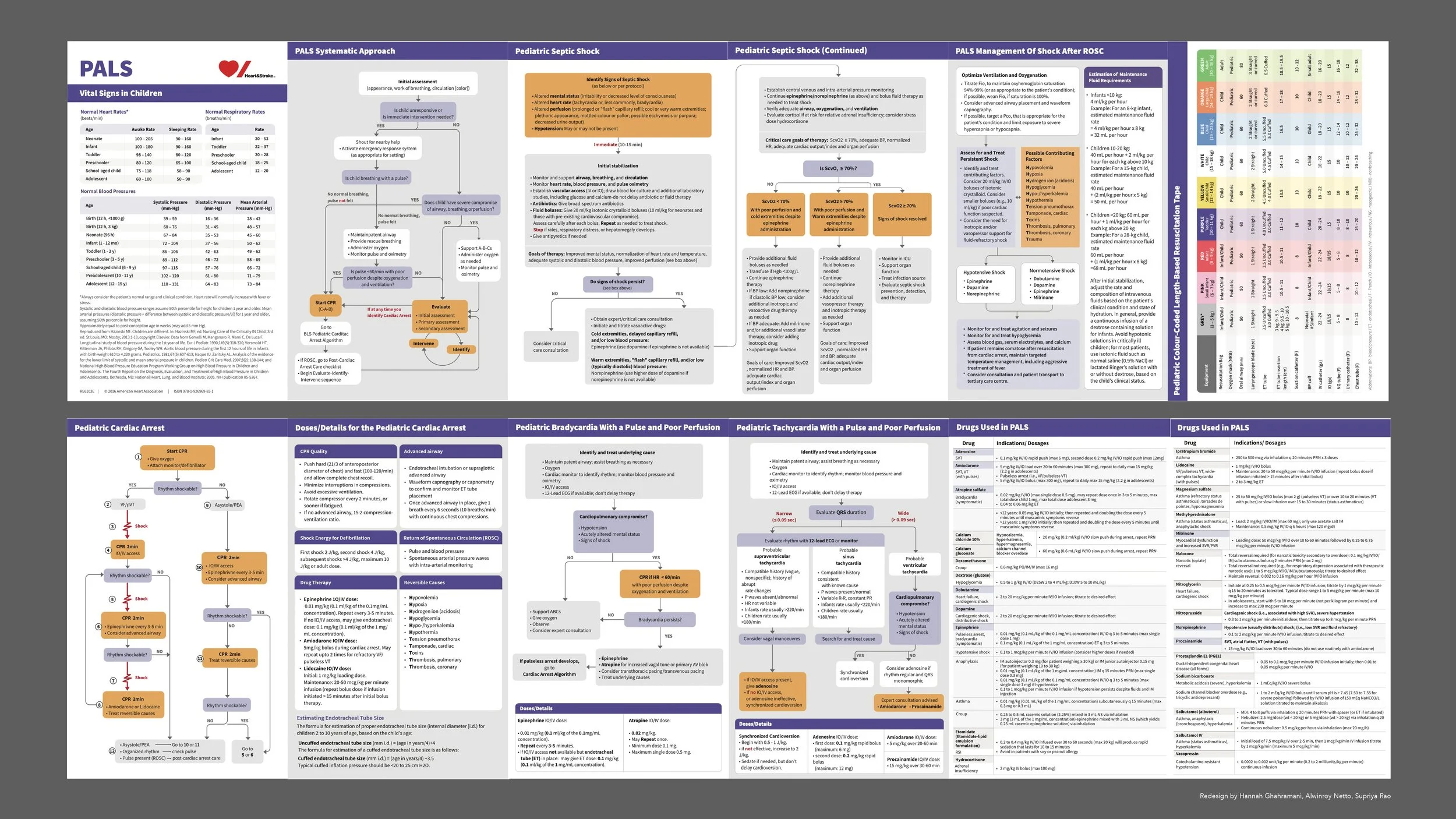
Redesigning the PALS Pocket Reference Card
Keywords: information design, cognitive aids, paediatric medicine
CONTEXT
The Pediatric Advanced Life Support (PALS) Pocket Reference — known as the PALS card — is a learning and cognitive aid used during pediatric resuscitations. Over time, the card has grown increasingly complex, raising questions about whether its design still supports fast, accurate information retrieval in high-stress emergency situations.
This study set out to understand how healthcare providers actually use the card in practice, and where its design falls short.
RESULTS
Three usability themes emerged from the simulation data: organization, information overload, and readability. Participants referenced the card a median of 19 times per simulation, with the card capturing a median 14% of total visual attention. The most frequently accessed sections were the algorithms, the Hs and Ts mnemonic, and defibrillation dosing.
Among the 50 survey respondents, 77% found the card useful during resuscitations — but 50% did not find it easy to locate information, and 70% did not find the card clear. The most-used features were drug dosing (78%), cardiac arrest algorithms (76%), bradycardia and tachycardia algorithms (64% each), and length-based equipment information (58%). In resuscitations, 50% reported using their own card while 42% rely on cognitive aids posted on the wall.
Based on these findings, the PALS card has been redesigned and is currently in the testing phase. An evaluation of the redesigned card as a cognitive aid for information retrieval has been accepted for poster presentation at the 2026 Western Medical Student Summit, Vancouver, BC.
PROJECT TEAM
Lynn M. Jacoby, MD (PI)
Jonathan P. Duff, MD
Jessica L. Foulds MD
Gillian Harvey, Art & Design
Lorraine Hodson RN Geraldine St. Jean RN BScN ENC (C)
Karsten A. Loepelmann, PhD’
Brenda Hiu Yan Law MD MSc University of Alberta Edmonton, Alberta, Canada
FUNDER
This project was funded by a WHCRI Grant.